Monday, January 23, 2023

PRE-APPROVAL IN 2023: WHAT YOU NEED TO KNOW


 One of the first steps in your home-buying journey is getting pre-approved. To understand why it’s such an important step, you need to understand what pre-approval is and what it does for you. Business Insider explains:

“In a preapproval [sic], the lender tells you which types of loans you may be eligible to take you, how much you may be approved to borrow, and what your rate could be." 

Basically, pre-approval gives you critical information about the home-buying process that’ll help you understand your options and what you may be able to borrow.

How does it work? As part of the pre-approval process, a lender will look at your finances to determine what they’d be willing to loan you. From there, your lender will give you a pre-approval letter to help you understand how much money you can borrow. That can make it easier when you set out to search for homes because you’ll know your overall numbers. And with higher mortgage rates impacting affordability for many buyers today, a solid understanding of your numbers is even more important.

Pre-Approval Helps Show You’re a Serious Buyer

Another added benefit is pre-approval can help a seller feel more confident in your offer because it shows you’re serious about buying their house. A recent article from Forbes notes:

“From the seller’s perspective, a preapproval [sic] letter from a reputable local lender often can make the difference between accepting and rejecting an offer."

This goes to show, even though you may not face the intense bidding wars you saw if you tried to buy during the pandemic, pre-approval is still an important part of making a strong offer. In fact, Christy Bieber, Personal Finance Writer at The Motley Fool explains it may be the most important part of making an offer:

“Pre-approval maximizes the chances you’ll be able to actually close the deal-and sellers want to see that. 

The fact that a pre-approval gives you a better chance of getting your offer accepted is undoubtedly the most important reason to complete this step..." 

Bottom Line

Getting pre-approved is an important first step toward buying a home. It lets you know what you can borrow and shows sellers you’re serious about purchasing their home. Connect with the Rural KC Team-Keller Williams Partners and a trusted lender so you have the tools you need to purchase a home in today’s market.  913-837-0760 or 913-837-0411, or Bill@ruralkc.com or Danicia@ruralkc.com.  We have a list of several great lenders on our "Resource" page of the website.WWW.RURALKC.COM. 

Monday, January 16, 2023

KEY TERMS TO KNOW WHEN BUYING A HOME


Some Highlights

  • Buying rural property is a major transaction that can seem even more complex when you don’t understand the terms used throughout the process.
  • If you’re looking to become a rural property owner this year, it’s important to know these housing terms and how they relate to the current market so you feel confident throughout the home-buying process.
  • Work with a trusted real estate agent, The Rural KC Team-Keller Williams Partners, who can answer any questions as they come up.  913-837-0760 or 913-837-0411. RURALKC.COM

Tuesday, January 10, 2023

Maintaining Your Horse’s Weight During the Winter

I have the easiest keeper in the barn. He lives out 24/7 on the grass with free-choice hay as needed and is fed only a ration balancer. Now that winter is officially here and the grass is sparse, should I be feeding more than just a ration balancer? Does he need more calories to stay warm?

This is a common question I think many owners with easy keepers have this time of year. With us hunkering down during miserable weather, enjoying warm drinks, log fires, and winter food, it’s easy to feel like we should be feeding our horses out in the elements more, too. Certainly, some horses struggle at this time of year to maintain their condition and will need more calories, while others will burn more calories but might not need to be fed more. The extra calorie burn in these horses can be a useful weight management tool.

Knowing whether your horse needs extra calories is best determined by assessing the condition. This can be hard during the winter in an outdoor kept horse that might have a full winter coat or be bundled up under blankets, but I would encourage you to not only look at your horse but put your hands on him too. A winter coat can make a horse appear to be carrying more weight than he is, only to result in a nasty shock when he starts shedding out! Familiarize yourself with the 1-to-9 Henneke body condition scoring scale, and then run your hands over the six areas described (the crest of the neck, withers, behind the shoulder, across the rib cage, over the back in the loin area, and the tailhead). Do this every week or two to monitor condition changes over time and catch weight gains and losses quickly before they become problems.

Your horse will be burning more calories to stay warm in colder weather, especially if not blanketed. Whether this is a problem depends on his starting condition. If he came into winter a little overweight, the extra calorie burn can be a useful tool for weight reduction, especially in an easy keeper that may struggle with weight regulation the rest of the year. In fact, not allowing a horse that came into winter a little heavy to lose weight before spring can potentially set him up for compounded weight gain when he has access to pasture again. Over time this can lead to health issues.

On the other hand, if you have managed your horse’s weight well over the summer and, into the autumn, and he came into winter at an ideal weight, then additional weight loss would not be warranted. Therefore, it’s important to know where you currently stand. If he starts to become a little too light in condition, then I would recommend some additional calories during the cold weather.

For an easy keeper, calories are best added by feeding more hay. This is true for most horses in cold weather- not just easy keepers- because the fermentation process necessary for them to digest hay has the added benefit of generating heat that will help keep them warm. Feeding a few extra pounds of hay a day should provide the calories needed to make up for those lost keeping warm.

When monitoring weather conditions to determine if more hay might be needed, keep in mind that horses can struggle to maintain warmth more during wet weather than in dry cold weather if they get wet down to their skin.

By monitoring body condition throughout the winter, you can adjust your feeding program to ensure your horse reaches spring at a good weight. Do not be afraid to allow some weight loss as needed, and remember that horses evolved gaining and losing weight through the seasons. It is our job as managers to keep that fluctuation within an acceptable range, which for me is between a 4.5 and a 6 on Henneke body condition scoring scale.

Monday, January 2, 2023

FINANCIAL FUNDEMENTALS FOR FIRST TIME HOME BUYERS


Are you prepping to buy your first home? If so, one of the steps you should take early on is making sure you’re financially ready for your purchase. Here are just a few of the financial fundamentals you’ll need to focus on as you set out to buy a home.

Build Your Credit

Your credit is one element that helps determine which home loan you’ll qualify for. It also impacts your mortgage interest rate. While there are many factors that go into your mortgage application, a higher credit score could lead to a lower monthly payment in the long run.

So how do you make sure your credit is in the best shape possible when it’s time to buy? A recent article from NerdWallet lists a few tips you can use as you work to build and strengthen your credit. They include:

  • Tracking your credit and disputing any errors that show up on your reports.
  • Paying your bills on time. This includes making loan payments and paying down any open lines of credit.
  • Keeping your credit card balances low. Paying more than your minimum monthly balance when you’re able can help.

Automate Your Savings for Your House Fund

You might also be wondering how you can achieve your down payment savings goals. Bankrate provides buyers with a number of tips to help you save, including searching for down payment assistance programs and ways you can save more, faster. As the article says:

“One of the best ways to save for anything — including a down payment — is to set it and forget it. If you receive a regular paycheck, ask your employer to direct a portion of that payment into a savings account. If you’re a freelance worker or independent contractor, set up a recurring transfer from a checking account to a savings account to establish the routine.”

Get Pre-Approved

As you prepare for your purchase, you’ll also need to have a good grasp on your budget and how much you’ll be able to borrow for your home loan. That’s where the pre-approval process comes in.

Pre-approval from a lender lets you know how much money you can borrow for your home loan. And having that knowledge, plus an understanding of your savings, can help you decide on your target price range for a house.

From there, you can start browsing for houses online and see what’s available in your area in that general price point. This can help you really understand your options so you can start to picture your future home.

For Customized Advice, Build a Team of Professionals

Finally, the best way to make you’re prepared for your purchase is to connect with trusted real estate professionals. Having expert advisors in the industry will help you make strong decisions throughout the homebuying process based on your specific goals, finances, and situation. They know the market and can guide you toward the home of your dreams.

Bottom Line

If you’re ready to get the homebuying process started, connect The Rural KC Team-Keller Williams Partners to begin building your team of professionals today.  Go to our awesome website to begin your search. www.ruralkc.com


Wednesday, December 28, 2022

CONFUSED ABOUT WHAT'S GOING ON IN THE HOUSING INDUSTRY? LEAN ON A PROFESSIONAL


If you’re thinking about buying or selling a home, you probably want to know what’s really happening with home prices, mortgage rates, housing supply, and more. That’s not an easy task considering how sensationalized headlines are today. Jay Thompson, Real Estate Industry Consultant, explains:

“Housing market headlines are everywhere. Many are quite sensational, ending with exclamation points or predicting impending doom for the industry. Clickbait, the sensationalizing of headlines and content, has been an issue since the dawn of the internet, and housing news is not immune to it.”

Unfortunately, when information in the media isn’t clear, it can generate a lot of fear and uncertainty in the market. As Jason Lewris, Cofounder and Chief Data Officer at Parcl, says:

“In the absence of trustworthy, up-to-date information, real estate decisions are increasingly being driven by fear, uncertainty, and doubt.”

But it doesn’t have to be that way. Buying or selling a home is a big decision, and it should be one you feel confident making. To help you separate fact from fiction and get the answers you need, lean on a local real estate advisor.

A trusted expert is your best resource to understand what’s happening at the national and local levels. They’ll be able to debunk the headlines using data you can trust. And using their in-depth knowledge of the industry, they’ll provide context so you know how current trends compare to the normal ebbs and flows in the industry, historical data, and more.

Then, to make sure you have the full picture, they’ll tell you if your local area is following the national trend or if they’re seeing something different in your market. Together, you’ll use all of that information to make the best possible decision for you.

After all, making a move is a potentially life-changing milestone. It should be something you feel ready for and excited about. And that’s where an agent comes in.

Bottom Line

If you have questions about the headlines or what’s happening in the housing market today, connect with the Rural KC Team-Keller Williams Partners for expert insights and advice.

Monday, December 26, 2022

OVERCOMING FEAR AFTER A RIDING ACCIDENT


By

 Kristina Lotz

When I got back into riding five years ago, it had been eight years since I had really been around horses, much less sat on one. The eight-year break came after a bad riding accident when a horse that I was trying bucked me off. I spent six weeks in a wheelchair with a pelvis that was broken in three places. I needed two surgeries and six months of therapy before I could walk unaided. I was left with extreme fear. Overcoming that fear after the riding accident was something I never thought I could do. Instead, I sold everything that had to do with horses and wouldn’t talk about them.

I had grown up riding. I was the stereotypical no-fear, horse-crazy girl. And in a flash, that love had been taken over by heart-seizing fear. Just talking about horses would cause my heart to race and my breathing to get shallow. It was a fear that couldn’t really be reasoned with; it overpowered my body and made me want to run in the other direction.

The Goal of Overcoming Fear after a Riding Accident

But deep down, I wanted to get back on again. Finally, my husband said I should try. My first step was to go to an expo, just to be around some horses. We watched a mounted archery demonstration, and it sparked a passion in me. I wanted to do that. For the first time in eight years, something was battling with fear. It gave me a goal—something to focus on.

For the next two years, I would slowly push my fear down, thanks to a dutiful older Norwegian Fjord mare. She not only helped me get over those essential first steps, but I learned mounted archery with her.

The first revelation that helped me was to set small goals. One was just to get on. Then, to walk around. Next, try and trot. I didn’t canter for at least a year.

The second thing I discovered was to listen to myself. If the voice inside me told me not to do something, I listened. I needed to take it slow, and if all of me wasn’t ready, then I didn’t do it.

Third, I needed a dream—something to stay focused on that made me want to ride so badly that I could fight the fear. And that’s where a Gypsy mare came in. Ever since I saw my first Gypsy horse when I was in high school, I was smitten. As a little girl who had dreamed of owning a Clydesdale, they seemed perfect.

In June 2018, I found her. She was not too far away and was named Merida, after the bow-wielding Disney princess from the movie Brave. Could it be more perfect? One look into her eyes the day I went to see her and I knew she had to be mine.

Go Bitless?

She and I bonded quickly, thanks in part to my use of positive reinforcement training. But I could tell she wasn’t happy in a bit. My trainer suggested bitless. So did a friend at archery. But that scared me, which was odd since I had grown up riding in hackamores.

I knew I didn’t have more control with a bit than I did bitless, but again, my fear used the excuse of the unknown to rear its ugly head. But I wanted my mare to be happy. So, I got a side-pull.

The fourth important revelation I had for conquering fear is to breathe. Music helps psychologically, but also you have to breathe to sing. I sang a lot that the first day as I swung my leg over my now bitless mare. She was so much happier! We have been bitless ever since, even for competitions.

This brings me to my fifth discovery. Competition. It gives you goals, something to focus on. It gets you out of your bubble with other horse people. I really found my confidence at shows.

Since 2018, Merida and I have competed at local open shows, breed shows, and International Mountain Trail Challenge Association (IMTCA) mountain trail events, all bitless. She was the 2019 and 2020 Ambassador Mare for the Gypsy Horse Registry of America and the 2020 Halter and Performance Mare Champion.

We’ve won high-point awards at the open shows, and a Reserve Champion Trail title at a breed show. She was the 2020 worldwide high-point winner for the IMTCA pony division. And we were the 2019 International Registry of Bitless Equestrians’ Horse and Handler of the Year. But her most important win was helping me gain my confidence.

Remnants of Fear After a Horseback Accident

I still get a little fearful now and then. Unknowns are what really drive my fear, I think because it was an unknown horse that bucked me off. Now I actually push myself to do unknowns. In March 2021, we competed in IMTCA mountain trail bridleless and came in 4th place. That was a huge deal for me, not because of the placing, but because I had the courage to take my girl bridleless outside of our own arena.

I am not sure the fear will ever leave me completely, but I’ve learned how to stop listening to it—to respond to it with: “I can do this. You are wrong. You don’t have power over me,” instead of letting it control me. If you are struggling with the same fears, just know you are not alone. You can do it. Just take it one step at a time at your own pace.


Monday, December 19, 2022

MORTGAGE RATES ARE DROPPING. WHAT THIS MEANS FOR YOU.

Mortgage rates have been a hot topic in the housing market over the past 12 months. Compared to the beginning of 2022, rates have risen dramatically. Now they’re dropping, and that has to do with everything happening in the economy.

Nadia Evangelou, Senior Economist and Director of Forecasting at the National Association of Realtors (NAR), explains it well by saying:

“Mortgage rates dropped even further this week as two main factors affecting today’s mortgage market became more favorable. Inflation continued to ease while the Federal Reserve switched to a smaller interest rate hike. As a result, according to Freddie Mac, the 30-year fixed mortgage rate fell to 6.31% from 6.33% the previous week.”

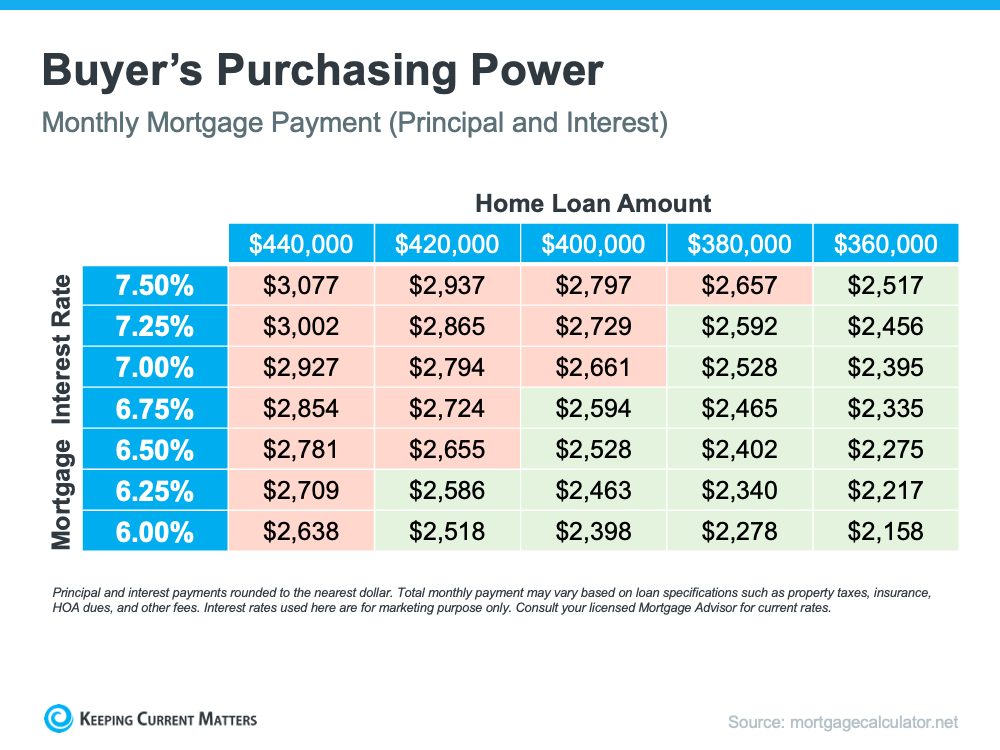
So, what does that mean for your homeownership plans? As mortgage rates fluctuate, they impact your purchasing power by influencing the cost of buying a home. Even a small dip can help boost your purchasing power. Here’s how it works.

The median-priced home according to the National Association of Realtors (NAR) is $379,100. So, let’s assume you want to buy a $400,000 home. If you’re trying to shop at that price point and keep your monthly payment about $2,500-2,600 or below, here’s how your purchasing power can change as mortgage rates move up or down (see chart below). The red shows payments above that threshold and the green indicates a payment within your target range.

Mortgage Rates Are Dropping. What Does That Mean for You? | Keeping Current Matters

This goes to show, even a small quarter-point change in mortgage rates can impact your monthly mortgage payment. That’s why it’s important to work with a trusted real estate professional who follows what the experts are projecting for mortgage rates for the days, months, and years ahead.

Bottom Line

Mortgage rates are likely to fluctuate depending on what happens with inflation moving forward, but they have dropped slightly in recent weeks. If a 7% rate was too high for you, it may be time to contact a lender to see if the current rate is more in line with your goal for a monthly housing expense.

The Rural KC Team-Keller Williams Partners has several lenders ready to talk with you.  Give us a call.  913-837-0760 or 913-837-0411. 

Wednesday, December 14, 2022

WHAT'S GOING ON WITH HOME PRICES?


If you’re thinking about buying or selling a home this year, you may have questions about what’s happening with home prices today as the market cools. In the simplest sense, nationally, experts don’t expect prices to come crashing down, but the level of home price moderation will depend on factors like supply and demand in each local market.

That means, moving forward, home price appreciation will continue to vary by location, with more significant changes happening in overheated areas. Here’s a quick snapshot of what the experts are saying:

Danielle Hale, Chief Economist at realtor.com, says:

“The major question on the minds of homeowners and aspiring buyers alike is what will happen to home prices. . . Soaring prices were propelled by all-time low mortgage rates which are a thing of the past. As a result, home price growth is expected to continue slowing, dipping below its pre-pandemic average to 5.4% for 2023, as a whole.”

Mark Fleming, Chief Economist at First American, says:

“House price appreciation has slowed in all 50 markets we track, but the deceleration is generally more dramatic in areas that experienced the strongest peak appreciation rates.”

Taylor Marr, Deputy Chief Economist at Redfin, says:

“For those bearish folks eagerly awaiting the home price crash, you’ll have to keep waiting. As much as demand is pulling back supply is as well reducing downward pressure on prices in the short run.”

John Paulson, Founder of Paulson & Co., says:

“It’s true – housing may be a little frothy. So housing prices may come down or they may plateau . . .”

What Does This Mean for You?

The best way to get the answers you need is to lean on a local real estate advisor. They’ll be able to explain the latest trends in your specific market so you can make a confident and informed decision on your next step toward buying or selling a home.

Bottom Line

If you have questions about what’s happening with home prices today in the Kansas City area, please contact the Rural KC Team-Keller Williams Partners at 913-837-0760 or 913-837-0411.  We would be happy to answer your questions. 

Tuesday, December 6, 2022

WHEN HORSES REACH RETIREMENT AGE


 A horse’s health and soundness dictate retirement more so than age. Most horses do better when retirement happens gradually, through a slow decrease in activity level based on the horse’s physical abilities and mental attitude.

When is the right time?

Assessing your horse’s physical and mental status isn’t always easy. Horses tend to decline over a period of time; they have bad days and good days. Look for trends in health and behavior, as they will tell you more about your horse’s status than one bad day. Your veterinarian, farrier, and trusted trainer are valuable partners in this process. Since they don’t see your horse every day, they will be more likely to notice changes in attitude, gait, weight, and energy levels. The decision may be easy if a horse becomes acutely ill or lame; otherwise, utilize the diagnostic tools available to you to assess the severity of problems as they arise. Consider test results and professional feedback when making decisions, but most of all listen to your horse. Retirement is a period of continual adjustment for both of you.

Signs that it is time to slow down.

Your horse starts aging the day he or she is born. All through life she adapts to the changes in her body and keeps working for you. But at some point the process begins to take a toll physically and mentally, and that is when it is time to make some changes. If you don’t listen to your horse and begin to reduce her workload, it can accelerate the aging process and contribute to serious illness or injury. When accessing your older partner, be on the lookout for signs:

  • Attitude changes (depressed, sour, anxious)
  • Dry coat or a change in shedding patterns
  • Digestive changes: dry or wet manure, recurring mild colic episodes, change in appetite
  • Increased number of “off days”
  • Less stamina during work or more soreness after exercise sessions
  • Loss of athletic ability and flexibility
  • Mild, intermittent lameness or shortening of stride
  • Poor behavior when ridden: bucking, rearing, kicking out, head tossing, resistant
  • Stiffness and soreness that remains even after being warmed up
  • Stumbling on smooth footing
  • Swayback or other conformation changes
  • Swaying or moving as you mount (a sign of weakness or balance problems)
  • Shortness of breath, chronic cough or noisy breathing
  • Vision impairments: seems more spooky, does not adjust well to changes in light intensity
  • Unwillingness to do certain activities he used to be comfortable with
  • Weight loss or loss of muscle mass

Adjusting to retirement

A complete shutdown of activity is bad for a horse. Many an older horse is miserable going from an active lifestyle to standing by the pasture gate all day. Inactivity can exacerbate some problems, such as arthritis or metabolic disease. Older horses left turned out in a pasture to fend for themselves rarely do well.

Depending on your horse’s status, his retirement may consist of nothing more than a shorter show schedule or less-strenuous trail rides. Perhaps you change his job. Many older horses have “been around” and make wonderful mounts for beginner riders. Dropping down a few competitive levels may be just what the veterinarian ordered. The key is to monitor your retiree carefully; don’t underestimate how much a horse may miss his old life and old friends.

Check on your horse daily

Is he happy and willing? Is he able to physically handle his current workload? It is helpful to keep a daily journal and look for patterns of change instead of overreacting to a bad day. As aging continues you can make adjustments as needed. When riding is no longer an option there are other ways you can interact with your horse: hand walking on trails, hand grazing, being ponied off another horse while you go for a walk around the fields, long grooming sessions or a bath. Just hanging out together. An old friend can always be enjoyed.

Lots of TLC

It is imperative to interact with your horse every day, even if you aren’t riding him or her as often. A daily grooming session is a perfect time to check your horse over and evaluate his condition and attitude. Make feed and forage changes slowly. Don’t abruptly take an older horse off supplements they have been getting for a long period of time. When problems arise, get your retiree checked out immediately; don’t just attribute the issue to “old age” and leave it to get worse. Continue to provide routine veterinary, farrier, and dental care. Most of all, cherish the time you have to spend together.

If you are in the market to buy or sell an equine property, give the Rural KC Team-Keller Williams Partners a call.  We can help.  913-837-0760 or 913-837-0411.