Wednesday, November 10, 2021

FARM ANIMALS ARE BENEFICIAL TO YOU AND YOUR FAMILY'S HEALTH

People are drawn to country life, homesteading and hobby farming for different reasons. 

Some relish the peace and quiet of being surrounded by acreage, others draw pleasure and purpose from gardening and working the land or achieving greater self-sufficiency.

But for many of us, the desire to go-rural is driven by our love of animals.

If you’ve been looking for a good excuse to upgrade from house pets to farm animals, check out these 5 ways keeping farm animals can help keep your entire family healthier and happier. 

#1: Farm animals reduce the risk of asthma and allergies in children and babies

While it may seem counter-intuitive, researchers at Johns’ Hopkins University discovered that babies exposed to dirt, animal dander (yes!) and germs had a lower risk of allergies and asthma later in life than children raised in cities or towns.

Other studies conducted on Amish children have shown the same results: the more time kids spend with farm animals, the significantly lower their risk of asthma and allergies.

Our next point explains why this phenomenon occurs...

#2: Keeping farm animals can significantly boost your immunity

Not only does being around farm animals help lower a child’s risk of asthma and allergies, but studies have proven farm kids tend to have stronger immune systems, more resilient gut microbiomes and less chronic childhood disease than city kids.

Many of these health benefits are due to the microbe-rich barnyard dust that children inhale, which (believe it or not) challenges and strengthens their immunity over time.

Additionally, spending time outdoors tending to animals exposes us to natural sunlight which helps boost vitamin D levels. Plus, farm chores promote regular exercise and movement—all of which strengthen immunity.

#3: Farm animals provide healthier food & superior nutrition

grassfed beef

There’s a certain level of satisfaction that comes from growing and raising your own food; and research has confirmed that raising your own animals for meat, milk and eggs has some impressive health benefits.

For example, a study from Penn State showed that chickens raised in their natural environment, with plenty of access to the outdoors, green grass, worms, grubs, etc. produced eggs with double the amount of vitamin E and omega 3 fatty acids, a more favorable ratio of omega 3 to omega 6 fatty acids (which helps your body fight inflammation) and a higher concentration of vitamin A.

Dairy cows raised on pastures give milk which is higher in essential fatty acids like anti-inflammatory omega 3 and CLA (conjugated linoleic acid). And many dairy farmers and health enthusiasts swear raw milk, aka: “farm milk” is easier to digest, tastier and less allergenic than pasteurized homogenized milk.

And beef cattle raised on grass produce a leaner healthier meat higher in omega 3s, CLA, precursors to vitamins A and E (such as carotenoids which give the fat a yellow hue) and the antioxidants glutathione and superoxide dismutase; all while being lower in fat and cholesterol than grain-fed cattle. 

Plus, if you’re raising your own animals you have total control over what goes into their bodies— which typically results in less antibiotics and artificial hormones...and that’s good for everyone.

#4: Caring for farm animals protects your mental and emotional health too

You’ve probably read about the health and longevity benefits of house pets, but science shows that farm animals can impact your mental and emotional well-being too.

Horses, for example, have long been used as therapy animals for children and adults with disabilities; and horseback riding through equine programs has been shown to help quell stress and anxiety in teens by reducing cortisol levels.

Beyond equine therapy, Care Farms have shown promising benefits for those with mental, emotional, memory and behavioral health issues. 

A Care Farm is a special non-institutional setting where people can interact with and care for farm animals as part of their healthcare treatment program. On a Care Farm, useful work while interacting with animals forms the basis of the therapy.

The animals on these Care Farms have shown great promise in providing participants with a variety of mental and emotional benefits including: 

  • Meaningful daily occupation
  • A way to connect and create valued relationships
  • Better coping skills
  • Opportunities for reciprocity
  • A distraction from their problems
  • A source of relaxation
  • Enhanced feelings of acceptance and purpose
  • Healthy relationships with other people on the farm
  • Stimulating healthy behavior
  • Opportunities for reflection and feedback

Additionally, farmers on Care Farms have noted the animals provide a “mirror” for the participants, which helps them see how their own behavior and attitudes directly affect others.

Research has also shown Care Farms provide structure, purpose and stimulus which benefit those with dementia.

Care Farms

#5: Farm animals and pets help protect your heart health

Strange, but true. 

Research from the American Heart Association has shown regular interaction with animals benefits your heart health by:

  • Lowering blood pressure and cholesterol
  • Reducing stress
  • Improving physical fitness 
  • Reducing the risk of obesity

Plus, animals provide companionship and purpose—both of which are important in protecting your heart health and longevity.

If you are interested in moving to the country, please feel free to contact the Rural KC Team-Keller Williams Partners, Inc. at 913-837-0760 or 913-837-0411,


Thank you to Kristen Boye with ReThink Rural for this blog post.


Tuesday, November 2, 2021

PAINTING CONCRETE FLOORS


When most people think of flooring, they picture things like carpet, wood flooring, tiles, and other common floor coverings. There are other options available to homeowners though, including concrete floors. While concrete was once seen mostly in places like basements and garages, it’s becoming increasingly common on the main floor of homes as well. Concrete flooring with built-in radiant heating systems is becoming a lot more popular, especially in areas that tend to have more severe winters.

Some people think that concrete flooring is limited in its decorative options, assuming that the only thing you can do with concrete is to apply a sealant or stain. There are other options available, though, including painting the concrete. But be careful before just slapping a coat of paint onto a concrete floor; there are a few things that you should know first.

Prepping the Surface

One of the biggest problems that people have with concrete floors is trying to paint them without having adequately prepped the concrete surface first. In order for paint to adhere to concrete well, the surface needs to be rough enough for the paint to get a good hold, and it also needs to be clean and dry. This can mean a little more prep time than some other types of flooring, but the end results are definitely worth it.

Seal any cracks in the concrete with concrete filler, then sweep the concrete to remove any dust or lose debris. Scrape off any old paint or other materials that are stuck to the floor. Wet the floor with a sprayer or mop, then apply a concrete degreaser and scrub the surface with a stiff-bristled broom to clean it. Rinse well and clean up any excess water with a wet/dry vac so that the surface can dry completely before you start painting.

Painting and Sealing

Once your floor is completely dry, it’s very important to put down at least one or two coats of primer that’s designed for use with concrete before you actually start painting. Tape off all of the baseboards and other areas that you want to protect, then start applying your primer at the edges and work toward the middle. Try to get each coat applied in a single painting session, as you don’t want to let the primer dry in patches that will show through in the final paint application. Allow each coat a chance to dry completely before starting on the next, waiting up to 24 hours if necessary to ensure that it’s fully dry.

Once you’ve applied your primer, it’s time to start painting. Use a concrete-friendly epoxy paint and follow the same application instructions that you used with the primer. Get good coverage along all of the edges before moving in toward the center and allow each coat a chance to dry completely. Once your paint is completely dry, apply a concrete sealer and follow the manufacturer’s directions to ensure that it cures properly. Ventilation and proper masking are especially important for this step, as come sealers can release fumes that you don’t want to breathe.

Understanding the Project Scope

Painting concrete floors can be intimidating because the process is a bit more involved than your standard paint job. If care isn’t taken to ensure that the floor is properly cleaned beforehand and sealed afterward then you can end up with bubbles and peeling paint down the road. Getting all of your materials together before the job starts and following all material instructions will save you a lot of trouble in the long run, since you won’t have to stop to go get something or run into issues with improperly applied coats.

If you have any questions or comments, please feel free to contact the Rural KC Team at 913-837-0760 or 913-837-0411.  Have a great day!

Tuesday, October 26, 2021

CLEANING YOUR TOUGHEST PATIO AND DECK STAINS


After a long summer, it’s time to clean up around your home and get everything in good shape before the winter comes. Not only does this sort of fall cleaning help your home look nice after the rain and heat of summer, but it can also aid you in finding issues or damage that you might want to take care of as you winterize your home. Some areas that often need particular attention during these cleanup periods are patios and decks.

Part of the reason for this is that many people use their patios and decks more during the summer than at any other time of the year. Various spills, dripping grease and oils from grilling, and assorted other messes can end up on the wood, while changes in weather over the course of the summer can encourage the growth of things like algae and mildew. Knowing how to effectively clean up all of these stains and other issues will not only make your deck or patio look better, but can also result in them lasting significantly longer without needing repairs.

Deck Stain Removal

Effectively cleaning up the various stains that occur on your deck or patio becomes a lot easier if you know the source of the stain. Grease stains, sauces, and similar spills can usually be cleaned with dish soap and a stiff-bristled brush, followed by washing the area thoroughly before it has a chance to start drying again. Dish soap can also be used to remove stains from decomposing leaves; allow it to sit and penetrate for 10 or 15 minutes before scrubbing and rinsing the stains away.

Other types of staining may require different solutions, however. Rust stains may need to soak in a mix of water and white vinegar or specialized acid cleaners to remove the discoloration. Tree sap can also be stubborn and difficult to remove, often needing dedicated deck or patio cleaners or cleaning solutions such as liquid oil soap cleaners. Some stone patios may require specific cleaners that won’t damage the type of brick or stone that’s used as well.

Dealing with Algae, Moss, and Mildew

Discolorations caused by algae, moss, mildew, and mold are usually a bigger problem than other stains, even though the other stains may be more common. The problem with algae, mold and similar growths is that they actually cause damage to the wood or stone of your patio or deck and need to be dealt with as soon as possible. Some growths like moss can be removed with soap, water, and a stiff-bristled brush, but things like algae and mold typically require a bit more. Because these grow into the wood or stone and thrive in moist environments, you’ll need a cleaner that can actually kill them and prevent them from coming back. In some cases, a bleach/water mixture will do the trick, combined with some scrubbing and general cleaning afterward. Special deck and patio washes are also available that are formulated to kill mildew, mold, algae, and similar growths, helping to ensure that you take care of the problem without having to try out different DIY mixtures.

Professional Cleaning

If you haven’t had much luck getting your deck or patio clean or simply don’t have the time to dedicate to the cleanup, there are professional services available that can get the job done for you. They typically use cleaners that are designed for the types of cleanup you need and may employ tools such as a power wash sprayer to really get into all of the places that are hard to reach with a brush or a broom. Depending on the service, they may apply new sealants or other protectants after your deck or patio is clean as well to help you weather the winter unscathed. 

As always, if you have any questions, or would like to buy or sell rural property, The Rural KC Team-Keller Williams Partners, Inc., is the one to call.  913-837-0760 or 913-837-0411.


Wednesday, October 20, 2021

WHAT SHOULD YOU DO WITH YOUR REMODELED FIXER-UPPER?


What Should You Do With Your Remodeled Fixer-Upper?

Buying a fixer-upper to renovate is an appealing investment opportunity for some, but once the property is repaired, should you rent it out or sell it? In some areas, renting can be a reliable long-term revenue stream, while in others, it makes more sense to sell. If you’re not sure what the best move is, use this advice from the Rural KC Real Estate Team to help you decide.

Tips for Making a Property More Desirable

The trick to making money flipping homes is to find a property that's undervalued, then make small improvements to get a better price for it. Some of the simplest improvements are ones that increase a property's curb appeal.

For example, a property with a garden might look a lot better with a fresh lawn and a new fence. If you're not skilled at this kind of work yourself, you should hire a fencing contractor. Don't just hire the first contractor you find, though—read Angi fencing reviews online and get multiple quotes. The average cost of a new fence is around $4,500, but actual prices vary depending on the materials, the size of the fence, and your area. Choose a contractor who's licensed and insured, and make sure they check the area for any underground utilities before starting work.

Why Flipping Is Often More Convenient Than Renting

Flipping a property can offer a one-off profit. Many flippers follow the 70% rule. This rule dictates that the cost of a property and any repairs done to it should be no more than 70% of the value of the property after the repairs are completed.

Finding properties that are this undervalued can be difficult, but foreclosure auctions do still offer such opportunities. People who are experienced DIY enthusiasts and can make basic repairs themselves can often turn flipping into a revenue-generating side business this way.

A 30% return on investment can be appealing, but it's a one-off source of income, and once the repairs are completed, the flipper will need to find another property and do the work again to get the next payout. Unless you have enough funding to have more than one property on the go at a time, flipping can be stressful and the income stream may not be stable—especially compared to the monthly income of rental properties. There's a reason there are nearly 50 million properties being rented in the U.S.

The Responsibilities of Being a Landlord

Renting out properties can generate a steady income and could offer tax deductions, too. However, for landlords to benefit from tax deductions and property value appreciation, they have to do a lot more day-to-day work.

Many landlords find themselves having to pay property managers to handle the daily operations of their portfolios, as well as landscapers and other maintenance contractors to look after the properties. This can quickly eat into profits. Non-paying tenants can also be an issue because the process of evicting them can be long and slow in some states. Being a landlord is not easy money.

Have a Business Plan Before You Start

Property renovations should be approached like any other business. Whether you decide to rent out the renovated property or sell, it's a business decision. Run the numbers, talk to some professionals, and understand the market in your area before you start spending money.

Are you in search of an investment property or your forever home in the Kansas City area? Contact the Rural KC Real Estate team!

Wednesday, October 13, 2021

ARE YOU ON THE FENCE: RENOVATE OR MOVE????

The last 18 months changed what many buyers are looking for in a home. Recently, the American Institute of Architects released their AIA Home Design Trends Survey results for Q3 2021. The survey reveals the following:

  • 70% of respondents want more outdoor living space
  • 69% of respondents want a home office (48% wanted multiple offices)
  • 46% of respondents want a multi-function room/flexible space
  • 42% of respondents want an au pair/in-law suite
  • 39% of respondents want an exercise room/yoga space

If you’re a homeowner who wants to add any of the above, you have two options: renovate your current house or buy a home that already has the spaces you desire. The decision you make could be determined by factors like:

  1. A possible desire to relocate
  2. The difference in the cost of a renovation versus a purchase
  3. Finding an existing home or designing a new home that has exactly what you want (versus trying to restructure the layout of your current house)

In either case, you’ll need access to capital: the funds for the renovation or the down payment your next home would require. The great news is that the money you need probably already exists in your current home in the form of equity. 

Home Equity Is Skyrocketing

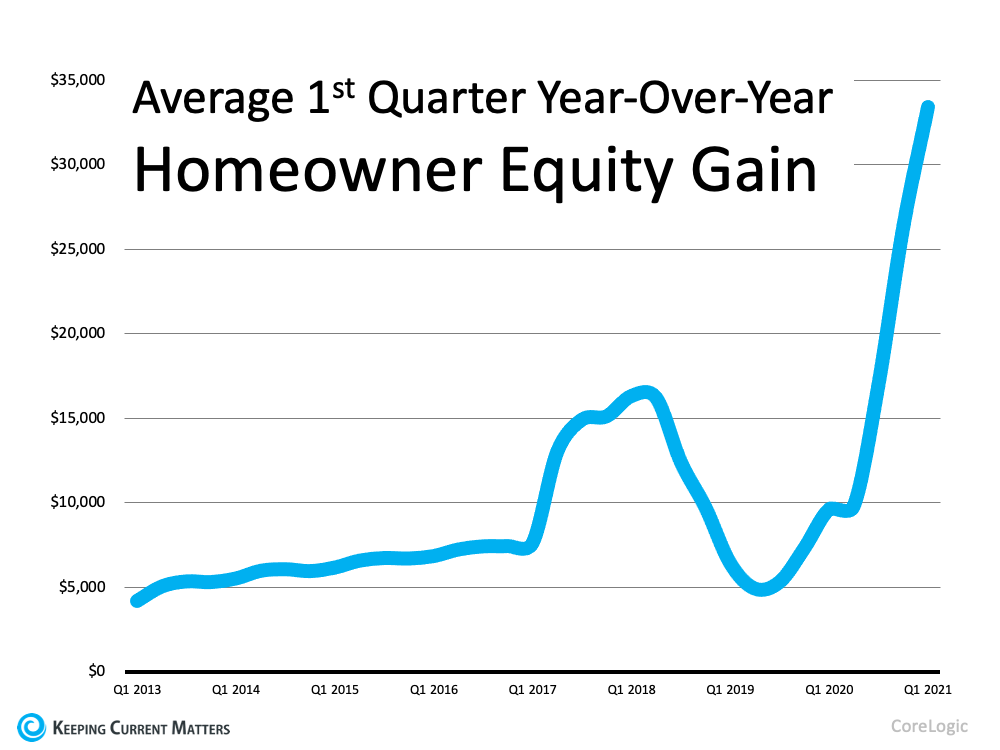
The record-setting increases in home prices over the last two years dramatically improved homeowners’ equity.  The graph below uses data from CoreLogic to show the average home equity gain in the first quarter of the last nine years:The Big Question: Should You Renovate or Move? | Keeping Current MattersOdeta Kushi, Deputy Chief Economist at First American, quantifies the number of equity homeowners gained recently:

“Remember U.S. households own nearly $35 trillion in owner-occupied real estate, just over $11 trillion in debt, and the remaining ~$24 trillion in equity. In inflation adjusted terms, homeowners in Q2 had an average of $280,000 in equity- a historic high.”

As a homeowner, the money you need to purchase the perfect home or renovate your current house may be right at your fingertips.  However, waiting to make your decision may increase the cost of tapping that equity. 

If you decide to renovate, you’ll need to refinance (or take out an equity loan) to access the equity. If you decide to move instead and use your equity as a down payment, you’ll still need to mortgage the remaining difference between the down payment and the cost of your next home.

Mortgage rates are forecast to increase over the next year. Waiting to leverage your equity will probably mean you’ll pay more to do so. According to the latest data from the Federal Housing Finance Agency  (FHFA), almost 57% of current mortgage holders have a mortgage rate of 4% or below. If you’re one of those homeowners, you can keep your mortgage rate under 4% by doing it now. If you’re one of the 43% of homeowners with a mortgage rate over 4%, you may be able to do a cash-out refinance or buy a more expensive home without significantly increasing your monthly payment.

First Step: Determine the Amount of Equity in Your Home

If you’re ready to either redesign your current house or find an existing or newly constructed home that has everything you want, the first thing you need to do is determine how much equity you have in your current home. To do that, you’ll need two things:

  1. The current mortgage balance on your home
  2. The current value of your home

You can probably find the mortgage balance on your monthly mortgage statement. To find the current market value of your house, you can pay several hundreds of dollars for an appraisal, or you can contact a local real estate professional who will be able to present to you, at no charge, a professional equity assessment report.

Bottom Line

If the past 18 months have refocused your thoughts on what you want from your house, now may be the time to either renovate or make a move to the perfect home.  If you are interested in making a move, please feel free to contact the Rural KC Team-Keller Williams Partners, Inc.  We can help you make a no-hassle move.  913-837-0760 or 913-837-0411.

Monday, October 4, 2021

HOW TO CHOOSE THE RIGHT PROJECTS FOR YOUR HOME


Deciding on which projects to invest in for your home is a big deal. If you’re moving, you want to avoid putting too much money into areas that won't create a return.  On the other hand, when you plan to live in your home for the long run, the benefits of your chosen upgrades aren’t always reflected in your home’s value. Fortunately, there are ways to balance your home projects so that you get the best of both: functionality and return on your investment.


If You Plan To Sell


Although we are stuck in what feels like a perpetual sellers’ market, there are still plenty of things you can and should rectify before putting your home on the MLS. According to home inspection provider US Inspect, this includes leaky toilets, slow drains, and tripping hazards, such as loose carpets. Other repairs or changes to the interior or exterior will be defined by the local market.


Your Rural KC agent can help you decide on any other upgrades, updates, or repairs needed before you sell. Keep in mind, however, that you will want to go ahead and plan to stage your home to maximize its appeal. A room-by-room organization system and new light switches don’t sound like much, but it will go a long way toward improving the perception of your home. Another idea is to get rid of extremely dark and oversized furniture and stage your home with modern options that brighten and widen each room.


When You Want To Stay


Deciding which improvements to make when you plan to stay in your home is much easier. A general rule of thumb is that if it increases your quality of life, reduces costs, or helps you better utilize your space, then it is a good investment.


During the spring, summer, and fall, it might be best to start with outdoor upgrades. You can build a patio and fire pit, for example. Both projects utilize pavers and a bit of ingenuity but are a great way to enhance your time outdoors. You might also consider fencing in your backyard, especially if you have a swimming pool. Keep in mind here that you will have to know your property line and, if applicable, any easements that you will have to workaround. In this instance, it might be best to outsource to a fencing company that will know how to pull the pertinent permits.


On the interior, focus on rooms that help you use them most efficiently. This might be your kitchen, where new countertops and appliances will go a long way toward creating a luxury cooking experience. You might also spend a weekend painting and installing new hardware in your guest bathroom. If you plan to have visitors in the near future, these little touches will help them feel more at home.


How To Know When You Need Help


You can do many projects on your own if you’re comfortable with tools and don’t mind doing a little research. But, there are some areas that you should always consult a professional first. Like installing a fence or other outdoor structure, the electrical, plumbing, and HVAC systems in your home require special permits or licenses. These are also expensive, and you have to have extensive knowledge in each area to ensure that it’s done safely and correctly. Poor workmanship here can cost you tens of thousands of dollars and put your family at risk.


Picking and choosing which projects to complete in your home aren’t always easy. When you plan to move, you’ll want to be extra selective to ensure that you are updating only what’s necessary for the home to be functional and more in demand than the next. But, when you plan to stay, don’t be afraid to go all out, even if it means calling in a professional. While you may spend more money, you’ll gain quality of life in a house that you’ve made your home.


Thank you to Mike Longston for his contribution to our blog this week.  As always, if you have an interest in buying or selling rural property, give the Rural KC Team a call.  913-837-0760 or 913-837-0411. Visit Ruralkc.com for the latest in country living.


Tuesday, September 28, 2021

COULD COUNTRY LIVING BE YOUR BEST PROBIOTIC


Do you spend a lot on probiotic supplements and fancy yogurts?

If so, you’re not alone. Probiotic food and supplement sales have surged over the last 10 years, thanks to exciting new research on “the human microbiome” showing how good bacteria benefits our health.

And this isn’t “fake” or “product-company-sponsored” research. This is the real stuff.

Just hop onto ScienceDaily, PubMed, or any scholarly database, and you will find thousands of peer-reviewed studies on how probiotics enhance gut bacteria diversity, which in turn can benefit everything from heart health and digestion to immunity and even your mood.

So how exactly does enhancing your gut bacteria diversity protect you from so many diseases?

You have probably heard that a huge portion of your immune system resides in your gut. Therefore, the more diversified your gut bacteria, the stronger and more resilient your immune system will be.

Probiotics play a role by infusing your gut with beneficial bacteria that allow for greater resiliency and strength against unfriendly bacteria, viruses, and other pathogens.

However, as many health experts will tell you, including those quoted in a 2016 New York Times article on autoimmunity entitled: "Educate Your Immune System", the body also needs the opportunity to fight off harmless bacteria and germs for optimal immune function…

…and that’s where farm life comes in.

As it turns out, farm and country living, with all its fresh air, animals, farm-fresh food, and regular contact with nature, provides a hefty dose of natural gut-diversifying, immune-boosting germs to protect your health.

It almost acts like an earth-based probiotic.

Read on to discover 5 ways farm and country life can provide you with the best (and cheapest) source of probiotics.


#1: Farm animals

Most farmers keep animals for production purposes such as providing milk, grazing pasture, or as a source of meat.

However, new research has revealed our furry friends have been providing us with some added health perks for millennia.

For example, a new study released last year in the New England Journal of Medicine showed Amish children who spent time around farm animals had a significantly lower risk of asthma than children who did not spend time with animals.

Researchers believe this is due to the microbe-rich barnyard dust the children inhale, which challenges and thereby strengthens their immunity over time.

Scientists are so convinced by their “barnyard dust hypothesis” that they propose a comparable spray be formulated for children who won’t have contact with farm animals in their early years.

Asthma rates among typical school-age children have risen dramatically to more than 10 percent in recent years, while the Amish maintain a low 2-4 percent asthma and allergy rate among childhood populations.

And there’s more good news for pet owners…

 Additionally, research has shown that living with dogs and cats can help enhance your gut bacteria, which is great news if you don’t live on a farm or keep livestock.


#2: Reduced levels of stress

Despite evidence about the role over-sanitizing, diet and antibiotics play in degrading gut bacteria balance, many experts believe stress may play the most significant role of all.

This has to do with that gut-brain connection we mentioned earlier. Here’s how that works:

Your gut and your brain are directly connected by what is now known as the vagus nerve.

This nerve acts like an information superhighway, shuttling information between your gut and your brain and vice versa. This explains the term “gut feelings” as your gut does experience whatever your brain tells it.

Based on this new finding, experts believe when we are under chronic mental and emotional stress, it eventually wears down our gut lining, resulting in compromised immunity.

One of the biggest benefits of country living is the natural escape it offers from common urban stressors like traffic, noise, crowds, and pollution.

In addition, spending more time outdoors in green space, escaping from noise pollution, connecting with animals, moving at a slower pace, and having regular contact with the earth have all been proven to significantly reduce stress and anxiety, which will benefit your gut health.

#3: Gardening, landscaping, and playing in the dirt

You have probably heard the expression: “a little dirt never hurt anyone.”

As it turns out, a little dirt could be just what the doctor ordered.

Researchers at Johns Hopkins have found infants exposed to dirt, dander, and other germs had a lower incidence of asthma and allergies.

This is believed to be due to specific microbes found in dirt strengthening babies’ developing immune systems.

For adults, children, and babies the simple act of gardening, landscaping, or playing in the dirt provides regular, safe exposure to a variety of immune-boosting bacteria and other microbes.

But the benefits of dirt don’t stop there.

According to researchers at the University of Bristol, soil microbes can help ease and prevent depression in adults.

The soil microbes work by boosting immunity by influencing the body’s production of cytokines which can enhance serotonin levels, thereby helping to alleviate depression.

Add to this what we learned in our previous point about gut-brain-connection, and one can see how a little time spent playing in the dirt could make a huge impact on your emotional well-being.

#4: Fresh, clean air

In our first point, we mentioned the beneficial effects of barnyard dust on asthma and allergy susceptibility in children.

This is a perfect example of how the air we breathe influences our gut health and immunity.

Though much of the science on fresh air and the microbiome focuses on indoor environments, the consensus is the more beneficial bacteria and germs found in the air, the better it is for your immunity.

This is great news for those living in rural areas, as they tend to have better air quality than big cities while maintaining a vast diversity of beneficial airborne microbes.

Add to that the proven benefits certain tree and plant essential oils have on our immunity, and you have a powerful immune-boosting ally in the fresh country air.


#5: Farm-Fresh-Foods

You have probably always suspected homegrown food is more nutritious than store-bought. What you may not have known is that homegrown foods are typically richer in gut-diversifying bacteria as well.

For example, fruits and vegetables picked fresh from the garden and washed simply with water will still retain some of those beneficial soil microbes we discussed earlier.

We hope that you enjoyed this blog post and gained some knowledge about probiotics and living in the country.  If you are in the market to buy or sell rural property, please feel free to contact the Rural KC Team, it's all we do.  913-837-0760 or 913-837-0411.  www.RuralKC.com.  Have a great day!


Kristen Boye is the editor of Rethink:Rural and the owner of Holistic Writing Concepts---a copy and content writing company specializing in the natural health and green living markets. Kristen lives with her husband and two children on their medicinal herb farm in beautiful rural Western North Carolina. Visit her online at: www.holisticwritingconcepts.com


Tuesday, September 21, 2021

GETTING YOUR HORSE BARN READY FOR FALL


Cold weather is quickly approaching, so follow these tips to ensure you're ready for the change of season.

1. Organize your blankets

Cold nights will start creeping in before you know it, so make sure each horse’s lightweight sheet is identified and cleaned, especially those who may be clipped. Keep tabs on the temperature lows each night as summer begins to turn into fall so you don’t lose sight of the nights when your horses may need light blanketing. Also, have the heavier blankets ready to go so winter doesn’t sneak up on you and leave you unprepared.

2. Make a plan with all the students (and parents) at your barn

It’s back-to-school time, which means busier schedules for most families that may board or train at your farm. Make sure you keep in touch with those who may be heading back to school so you can help manage their horses and their riding goals despite their busier schedules. This communication will lead to more successful outcomes for everyone as many commitments are being juggled by all parties.

3. Inspect your farm for damage or deterioration

Winter is prime time for problems such as leaky roofing, broken fences, loose hinges, insulation problems, footing issues, and more. You don’t want to save these fixes for the middle of winter when they’re hardest to repair. Survey your property for signs that things may need attention. Be sure your windows and doors are functioning properly to seal in the heat during the cold nights to come. Check on your water tanks and insulated pipes to be sure you won’t face any issues when freezing temperatures hit. If anything needs adjusting, the fall is the perfect time to make those repairs.

4. Have a severe weather plan in place

The fall can also bring with it the chance of severe weather in many parts of the country. Research how to prepare a farm structure for high winds and heavy rain ahead of time. As fall turns into winter, heavy snowstorms can put your horses at risk, limiting access to necessities for the horses. It helps in this scenario to have 10% more supplies on hand than you normally need to keep your stable full of horses safe and healthy in case of a weather shutdown. Above all else, stay tuned in to the news this fall so you won’t be caught off-guard if the weather starts to get dangerous in your area.

5. Decorate!

There’s nothing more fun than breaking out the fall décor as the leaves begin to change and the air gets a little cooler. The best part of decorating for fall is that decorations can stay up from September through November, so you can enjoy your efforts for a long time. Use horse-safe decorations to add some fall vibes to your barn, including pumpkins, string lights (out of reach of horses), scarecrows, and more. If you have jumps in your arena, add some hay bales, pumpkins, and colorful gourds to make them festive. You can even plan a socially distant Halloween party with a costume contest to get the whole barn involved in a fun activity.


As always, please feel free to give the Rural KC Team-powered by Keller Williams Partners, Inc.-a call at 913-837-0760 or 913-837-0411 for any questions you might have, or if you are interested in buying or selling rural real estate.  Have a great day!

Monday, September 6, 2021

IMPROVING FISH HABITAT IN PONDS


Fishing on your own farm pond can provide hours of relaxation and entertainment for adults and children alike.  However, it is important to know how to create and maintain the diversity of fish species. 

Small ponds are a valuable part of rural property and are therefore common features of many land tracts. 

Most farm ponds are stocked with largemouth bass and bluegill, occasionally adding channel catfish. Some owners want to focus on trophy bass primarily with fewer catchable fish in total. 

Others may desire a pond with large numbers of smaller fish that are easier to catch. The discussion here is for those farm pond managers interested in a balanced farm pond population.

In “Farm Pond Management for Recreational Fishing”, a publication from the University of Arkansas Cooperative Extension Program in cooperation with the Arkansas Game and Fish Commission, a balanced pond is defined as “one where both largemouth bass and bluegill populations have stable reproduction each year and there is a range of sizes from small to large in both species.”  

In general, the bluegill population should provide plenty of food for the bass and the bass population should keep the bluegill from overpopulating. 

Fish habitat is an important factor in farm pond management.

The cover allows juvenile fish to survive predation. Depending upon the type of cover, it may also contribute nutrients for insects that become food for fish.

Levi Kaczka, Coordinator for Region IV Fisheries in the South Carolina Department of Natural Resources, shared some of his thoughts on improving fish habitat in farm ponds.

“Farm ponds generally lack quality fish habitat without additions from owners since most are excavated from an otherwise open plot of land. When an owner thinks about adding structure, they should think of needs from the standpoint of both large (catchable) and small (juvenile not sought by anglers) fish since both are needed for a quality fishery.” 

In general, structures that may be added to ponds will fall into two categories.

The first is aquatic vegetation.

“Submersed aquatic vegetation is an excellent source of structure since it provides nursery habitat for juvenile fish,” says Levi. “This nursery habitat is beneficial for young fish both in terms of avoiding predation, as well as increasing the habitat for aquatic invertebrates that will provide forage for juvenile bass and all life stages of bream.”

With aquatic vegetation, there are also some concerns as it requires active management.

“Many folks are hesitant to introduce vegetation due to the common occurrence of it overrunning a shallow-water pond and the subsequent issues with oxygen depletion and the inconveniences to fishing,” adds Levi.

Along these lines, the website for the Missouri Department of Conservation says, “Too much cover is as detrimental to good fish management as too little.”

This excess cover allows small fish to be so well protected from predation that they overpopulate, get too little food, and don’t grow.  

As a rule of thumb, the Missouri Department of Conservation site suggests that no more than 10-20 percent of the surface area of a pond should have plant growth. They also note that this may require active thinning.

Levi suggests the alternative is to add hardcovers such as fallen trees, limbs, and brush along the shoreline. 

“These make great additions since they are organic material that will slowly break down over time and don’t cost much to replace. Additionally, they often provide varying amounts of interstitial space (the space between branches and hardcover) which is desirable in a bass and bream pond. The finer the structure and interstices, the more beneficial it will be as cover for small fish. The larger those spaces, the more beneficial for a bigger predator hanging out looking for a meal. Ultimately, you’d like to have both present.”

If you are thinking about sinking brush in your farm pond, the type of brush, location, and arrangement are all factors to think about.

“Some of my favorite material we put into the lakes on fish attractors are large Wax Myrtle bushes,” says Levi. “They seem to last relatively long before breaking down and provide varying sizes of interstitial space all in one or two bushes. Some other materials to consider may be leftover Christmas trees or bamboo, both of which can be anchored with cinder blocks or fixed in a small bucket of concrete.”

“As far as location, from the shoreline out to 10-15 feet works great,” says Levi. “Since most people are going to be fishing these small farm ponds from the bank, no sense in adding structure to areas outside of casting distance.”

The Missouri Department of Conservation site also recommends the brush should be sunk in sections of the pond where the top of the brush remains within 4-6 feet of the surface. Often, water of this depth is in the vicinity of the dam. Care should be taken that brush doesn’t interfere with the spillway or exit of water from the pond.

Also, this website references research suggesting that the placement of brush can impact fish concentration. For example, they note that in the case of sinking Christmas trees, three placed close together in a triangle will attract more fish than the same three trees spread out.

The second is sinking hard covers such as clean cinder blocks or pipes

This is especially helpful when channel catfish are one of the desired fish. Channel cats gravitate toward cavities for cover.

In conclusion, management of farm pond habitat can help provide a balanced fish population.  Whether you add aquatic plants or hardcover such as submerged trees may depend on the amount of time and money you wish to invest. But parting words from the Florida Fish and Wildlife Commission may be worth considering.

“The management of the ponds should take into account important conservation principles to prevent doing more harm than good.”

  If you are interested in buying or selling rural property, give the Rural KC Team a call.  913-837-0760 or 913-837-0411.  Have a great day!


Many thanks to Jim Mize for all of the great information.